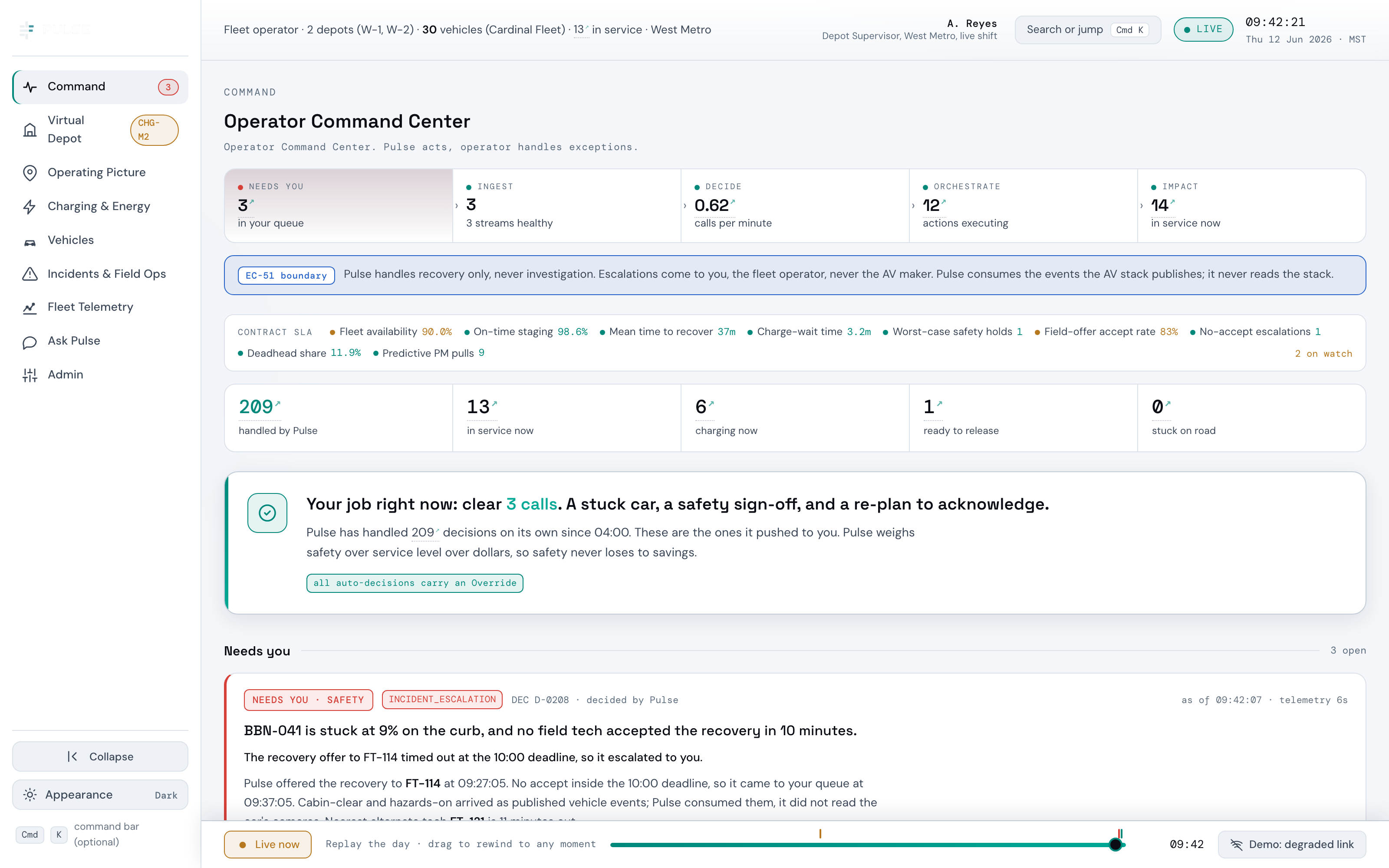
Backbone runs the ground game, so your fleet spends its day earning.
Your fleet, your depots, your city. Robotaxis, delivery fleets, shuttles: riders or goods, the vehicles need charging, cleaning, maintenance, staging, and recovery every single day. Nothing here gets replaced. It gets connected.
Pulse listens to what your systems already emit. No new hardware on the vehicle, and the driver stack stays sealed, always. This dashed line is the design's first promise.
Events come up, decisions go down. Pulse assigns every vehicle its next required action, machine to machine; the assignment lands in your dispatch and your stack drives. Your team stops chasing status and starts commanding exceptions.
Independent providers of charging, wash, maintenance, and recovery, certified once against one published standard per service. That standard is the SLA every operator inherits. They execute and carry the liability. Your capacity grows without new real estate.
For the platform above the operators: one read-only pane, apples to apples across markets. Three numbers: human share of cost, depot throughput, cost per in-service mile, computed against rate inputs each operator supplies. Every view runs under scopes the operator grants and can revoke. Nothing flows down. Operators use the same pane as their own proof of performance.
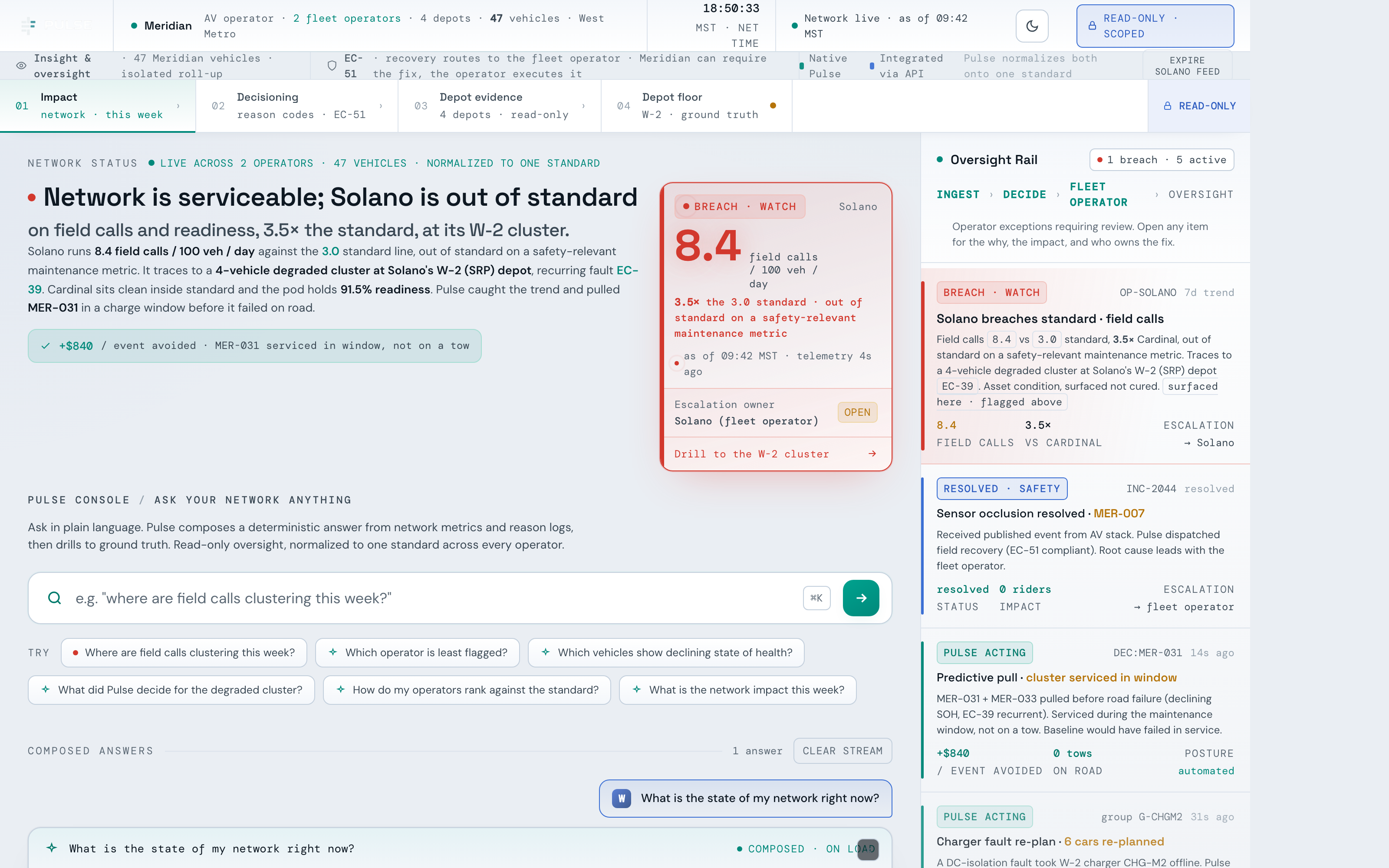
The boundary is not a slogan; it is an interface. Reads come from events the operator publishes; commands run under scopes, revocable API grants from the party that owns each interface: the operator for its fleet, the provider for its own infrastructure.
The team that ran the ground game for the giants now builds the layer that runs it for everyone.
AV depot operations, learned inside the fleet that defined them. Our operations leadership ran the ground game at Waymo before building it for everyone else.
Dispatch engineering at global scale. The systems that route millions of trips taught us how machines should hand work to machines.
A 60K-vehicle network, built from zero across 22 markets. At MAX we held the CTO, CGO, and President seats: we built the technology that ran the network, not just the business on top of it. Depots, chargers, drivers, uptime, the balance sheet, the battery-swap stations: we carried all of it.
The product starts on the ground because we did.
One depot runs itself. Then the city takes over, and every empty mile back to base becomes a short hop to the nearest service. Shorter is money.
More revenue miles, less deadhead, depot capacity without capex. Run the network or license the driver into fleets you do not operate: every deployment gets the same certified floor, and one read-only pane shows every operator and market on your network.
You are here: oversight, standing on every floorPulse embeds in your depot in weeks and runs the loop, whether you run fifteen vehicles or fifteen thousand. Certify your ground once against the published standard and work routes to it: your lots and depots can become certified capacity on the network, at your choice, and you keep your systems, your data, and your platform relationships.
You are here: the world + the control layerCertify once against the standard. Work routes by proximity and certification, never a price auction, and demand compounds with every fleet that joins the stack. Booked, scheduled load you can plan against, not walk-in traffic.
You are here: the service networkBuild the driver and run your own fleet? You hold both seats.
A minute thirty-eight, storyboarded below. One depot turns its fleet through the night and releases it, vehicle by vehicle, as inspections pass under the operator's standing release policy.
In 2023 the public robotaxi fleets were pilots; by 2026 they are opening new cities every quarter. Every launch, robotaxi, shuttle, or delivery, needs the same floor: chargers online, bays sequenced, providers held to standard. Building that floor once per operator is the industry's slowest, most duplicated work.
Every published event teaches the operating graph. Depot N+1 inherits what depot N learned about cycle times and sequencing, so it opens faster and runs cheaper. The graph learns process behavior only: aggregated, non-attributable, never anyone's records, never anything from inside the vehicle.
A vertically integrated operator learns from one fleet: its own. A neutral layer learns across every fleet that joins, and no operator's data changes hands. That is the part no one can build alone.
Weeks, not quarters. Week one, map the events your systems already publish. Week two, grant scopes and shadow-run the floor. Week three, the first supervised hands-off shift. Your engineers point the event stream, grant the scopes, and set the release policy; our forward-deployed engineers carry the rest, and in a first-fleet market, certification of your existing local vendors runs alongside those same weeks. Nothing to rip out, nothing new to buy.
One standard per service, written to be held in the open. Response time, turnaround, quality checks: versioned and auditable. Providers stay certified only while they hold it. The standard is the floor; your contracts can sit above it.
Providers execute and carry the liability. Backbone owns no depots, vehicles, chargers, or vendors; it orchestrates across them. Liability for each job sits with the certified provider who executes it.
Every fleet that outran the world had this layer. The Mongols called it the yam. Rome called it the cursus publicus. The Tokaido had fifty-three stations of it. Machines are getting theirs now.